
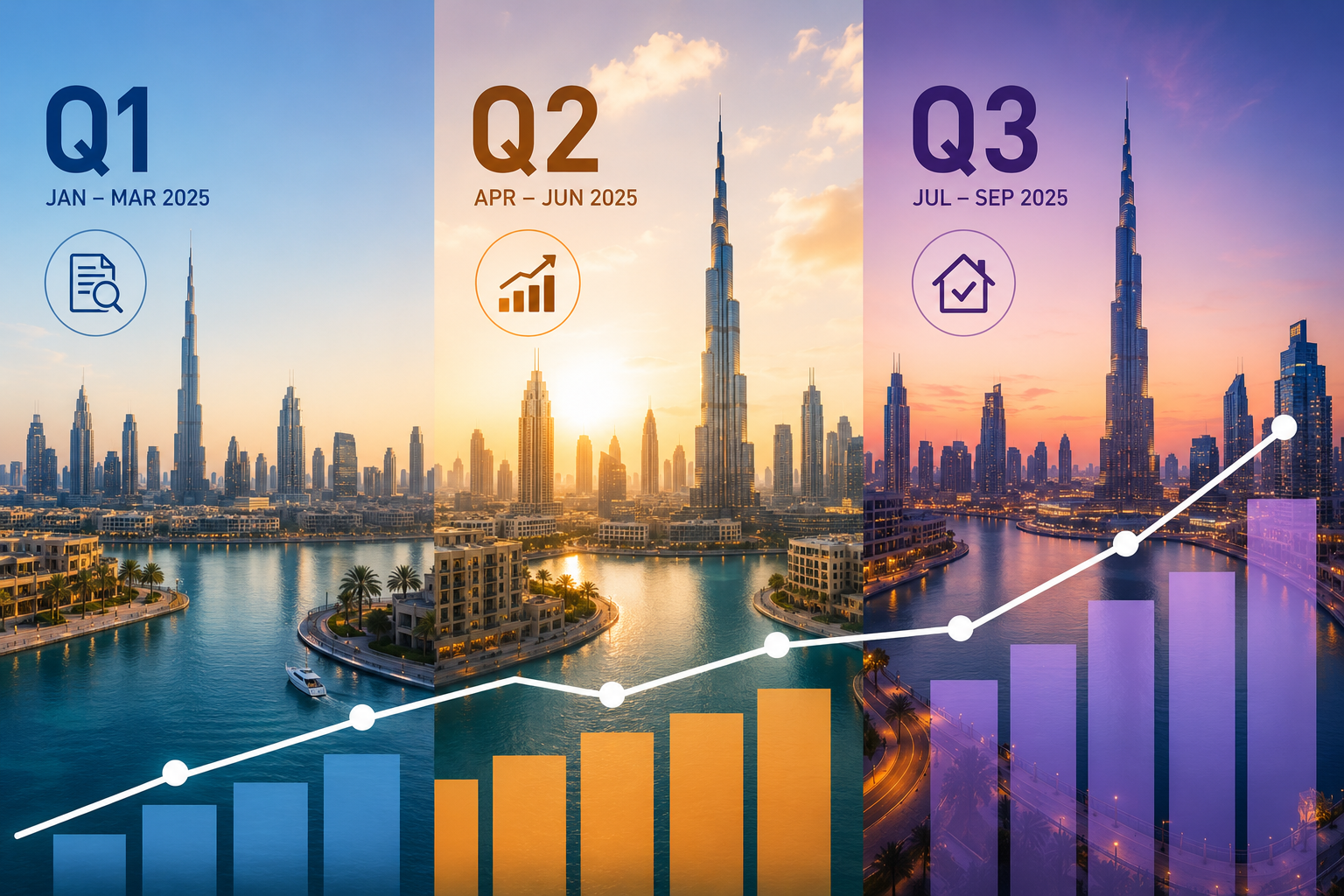
Dubai Property Market Report: First Three Quarters of 2025

Quick Answer
Dubai’s real estate market remained exceptionally strong during the first three quarters of 2025, recording approximately AED 499.5 billion in total sales value across around 158,300 transactions. That represents about 33% year-on-year growth in value and 21% growth in transaction volume. The average price reached approximately AED 1,600 per sqft, up around 8% year-on-year.
The real story is not just that Dubai grew. It is that Dubai’s market became broader, deeper, and more segmented. Off-plan continued to dominate volume, resale showed strong capital gains, mortgage activity grew with healthier buyer equity, and emerging communities kept attracting investor demand.
Key Takeaways
• Dubai recorded around AED 499.5 billion in sales during Q1–Q3 2025.
• Sales volume reached around 158,300 transactions, up approximately 21% year-on-year.
• Off-plan sales remained the dominant force, with about AED 324.2 billion in value and 108,600 transactions.
• Resale sales reached around AED 175.3 billion, showing continued strength in completed properties.
• Q3 2025 alone recorded around 59,228 transactions worth approximately AED 170.7 billion, confirming that activity remained strong into the second half of the year.
• Dubai’s wider real estate sector later closed 2025 above AED 917 billion in total transaction value across more than 270,000 transactions, confirming that the strong first nine months carried through to the full year.
• Supply risk should be monitored, but actual delivery timing matters. Cavendish Maxwell reported around 28,100 residential units delivered in the first nine months of 2025, with Q3 deliveries below initial projections.
Dubai Real Estate in Q1–Q3 2025: Strong Growth, But More Selective Than the Headline Suggests
The first three quarters of 2025 confirmed one thing clearly: Dubai’s property market was still in expansion mode.
A market reaching nearly half a trillion dirhams in sales before the end of September is not a normal market. It shows liquidity, confidence, and strong participation from both investors and end-users.
But the headline number does not tell the full story.
The real story is the structure behind the growth.
Off-plan dominated sales volume.
Resale continued delivering strong capital gains.
Mortgage activity increased, but buyers used lower leverage.
Developers kept launching aggressively.
Emerging zones gained momentum.
Mature communities remained liquid, but some started stabilizing.
This is what makes Dubai’s 2025 market important. It was not only a boom. It was a market evolving into a more complex cycle.
1. Market Snapshot: Nearly Half a Trillion Dirhams in Nine Months
Dubai recorded around AED 499.5 billion in total property sales during the first three quarters of 2025. Transaction volume reached around 158,300 deals, while average price per sqft reached approximately AED 1,600.
This performance was supported by several demand drivers:
• Population growth
• International investor inflows
• Strong rental returns
• Developer payment plans
• End-user confidence
• Dubai’s tax-efficient environment
• Long-term visa and business-friendly reforms
• Continued infrastructure expansion
The market was not driven by one buyer type only. It attracted investors, residents, entrepreneurs, relocating families, and high-net-worth buyers.
That depth is important because broader demand makes the market more resilient than a purely speculative cycle.
2. Off-Plan Remained the Main Growth Engine
Off-plan continued to dominate Dubai’s market during the first nine months of 2025.
The reported figures show:
• AED 324.2 billion in off-plan sales value
• Around 108,600 off-plan transactions
• Average price around AED 1,700 per sqft
• Value growth of approximately 33% year-on-year
• Transaction growth of approximately 26% year-on-year
This shows that buyers continued to trust developer launches and future communities.
The strongest off-plan demand came from areas such as:
• Jumeirah Village Circle
• Business Bay
• Wadi Al Safa 5
• Dubai South
• Jabal Ali First
Off-plan performed strongly because it offered what many buyers wanted: flexible entry, staged payments, new buildings, and exposure to future growth areas.
Why Off-Plan Kept Winning
Off-plan is attractive in Dubai because it gives buyers access to new inventory without needing to pay the full amount immediately.
Investors like it because:
• Payment plans reduce upfront pressure
• New projects are easier to market and resell
• Launch prices can offer upside if the area grows
• Developers create strong product stories
• Modern amenities attract tenants and end-users
• Emerging communities offer lower entry points
However, off-plan strength does not mean every project is a good investment.
The best off-plan investments still require:
• Strong developer reputation
• Fair entry price
• Realistic handover timeline
• Limited competing supply
• Good payment structure
• Rental demand after completion
• Resale liquidity before and after handover
In 2025, off-plan was powerful, but selection still mattered.
3. Resale Market Proved the Strength of Completed Property
The resale market also performed strongly during Q1–Q3 2025.
The reported figures show:
• AED 175.3 billion in resale sales value
• Around 49,700 resale transactions
• Average price around AED 1,500 per sqft
• Value growth of approximately 31% year-on-year
• Transaction growth of approximately 11% year-on-year
• Capital gains of approximately AED 56 billion, up around 66.6% year-on-year
This matters because resale is often a cleaner signal of live market demand.
Off-plan tells us how much confidence buyers have in future supply.
Resale tells us what buyers are willing to pay for completed property today.
The strong resale performance suggests that ready properties remained highly attractive, especially in communities with rental demand, limited availability, and strong lifestyle appeal.
Top resale apartment areas included:
• JVC
• Dubai Marina
• Business Bay
• Downtown Dubai
• Al Merkadh
This shows that mature and high-liquidity communities remained relevant, even as new communities gained attention.
4. Capital Gains Showed the Power of Secondary Market Liquidity
One of the strongest signals in the first three quarters of 2025 was resale profitability.
Capital gains reportedly reached around AED 56 billion, up approximately 66.6% year-on-year.
This means many owners who bought earlier in the cycle were able to resell with meaningful profit.
That is important because a healthy market needs exit liquidity.
Investors do not only care about buying. They care about whether they can sell later.
Strong capital gains suggest:
• Buyers still trusted completed property
• Secondary demand remained liquid
• Good communities had strong exit options
• Earlier investors were rewarded
• Price appreciation was not limited to off-plan launches
For investors, this confirms that resale should not be ignored. In many cases, the best opportunity may be a completed property with tenant income, proven demand, and clear resale comparables.
5. Mortgage Activity Grew, But Buyers Used More Equity
Mortgage activity remained important in the first three quarters of 2025.
The reported figures show:
• AED 132.5 billion in mortgage value
• Around 38,000 mortgage transactions
• Mortgage transactions up approximately 29% year-on-year
• Average Loan-to-Value around 72.6%, down approximately 5.5% year-on-year
This is a healthy signal.
More mortgage transactions show that end-users and financed buyers remained active. But lower average LTV suggests buyers were contributing more equity and relying less heavily on debt.
That matters because a market with stronger equity contributions is usually less fragile than a market driven by excessive leverage.
In simple terms:
Buyers were still borrowing.
But they were not stretching as aggressively.
This supports the idea that Dubai’s 2025 cycle was backed by stronger capital and more disciplined financing than previous boom cycles.
6. Supply and Development: Confidence Is High, But Absorption Must Be Watched
Dubai developers remained aggressive in 2025.
The source figures mention approximately 118,500 new units launched year-to-date, broadly similar to the strong launch activity seen in 2024.
This shows developer confidence, but it also creates an important question for 2026:
Can demand continue absorbing new inventory at the same pace?
Supply is not automatically negative. A growing city needs new homes. But supply becomes a risk if it arrives faster than population growth, rental demand, and investor absorption.
Cavendish Maxwell reported that Dubai delivered around 28,100 residential units in the first nine months of 2025, up 6% year-on-year. It also noted that Q3 deliveries were around 9,400 units, below the initial projection of 22,800 units, with a materialisation rate of 41.3%.
This is important because announced supply and delivered supply are not the same.
Many forecasts focus on pipeline numbers, but actual delivery timing is what affects real market pressure.
Supply Risk Is Local, Not Citywide
Future supply must be read by community and property type.
A large number of apartment deliveries in one emerging area does not automatically hurt prime villas. A wave of studios in one district does not necessarily affect waterfront luxury units.
Investors should ask:
• Which community has the most supply coming?
• What type of units are being delivered?
• Are they studios, one-bedrooms, townhouses, or villas?
• Are they affordable, mid-market, luxury, or ultra-luxury?
• Are projects on schedule or delayed?
• Is rental demand strong enough to absorb them?
• Will handover investors hold, rent, or resell?
This is where smart investors separate opportunity from risk.
7. Top Performing Areas Show Dubai’s Market Rotation
The first three quarters of 2025 showed strong demand across both established and emerging locations.
Off-Plan Apartment Hotspots
• Jumeirah Village Circle
• Business Bay
• Wadi Al Safa 5
• Dubai South
• Jabal Ali First
These areas benefited from developer activity, investor demand, and accessible entry points.
Resale Apartment Hotspots
• Jumeirah Village Circle
• Dubai Marina
• Business Bay
• Downtown Dubai
• Al Merkadh
These areas remained liquid because buyers trust established communities with rental demand and transaction history.
Off-Plan Villa Hotspots
• Al Yelayiss 1
• Al Yufrah 1
• Madinat Hind 4
• Dubai Investment Park Second
• Wadi Al Safa 5
Villa buyers continued looking toward developing family communities and master-planned areas.
Resale Villa Hotspots
• Wadi Al Safa 5
• Al Yelayiss 1
• Al Hebiah Fifth
• Dubai South
• Al Yufrah 1
This confirms that the villa market was not only about prime legacy areas. Newer family-focused communities also gained traction.
8. Market Insight: Prime Areas Stabilizing, Emerging Areas Growing
One of the most important 2025 signals was micro-market divergence.
Some mature areas, such as Downtown Dubai and Dubai Marina, showed signs of stabilizing after strong previous gains. That does not mean they became weak. It means they became more mature and price-sensitive.
At the same time, emerging areas continued showing stronger growth because they offered:
• Lower entry prices
• New launches
• Larger future upside
• Better payment plans
• Infrastructure-driven growth
• More available inventory
This is normal in a maturing cycle.
Early in a boom, prime areas often lead. Later, investors look for value in emerging communities.
That is exactly what the Q1–Q3 2025 data suggests.
9. Why Global Investors Continued Buying Dubai
Dubai’s international appeal remained one of the strongest drivers of market demand.
Global buyers continued to be attracted by:
• No annual property tax
• No personal income tax
• Strong rental yields
• Safety and lifestyle
• High-quality infrastructure
• International schools and healthcare
• Business-friendly environment
• Long-term residency options
• Strong air connectivity
• Wealth migration into the UAE
The Financial Times reported that Property Finder attracted a major private equity investment from Permira and Blackstone in 2025, reflecting broader confidence in Dubai’s property market and real estate technology ecosystem.
That kind of institutional interest matters because it shows that Dubai’s property market is no longer only attracting individual investors. It is also attracting global capital platforms.
10. Risks Heading Into 2026
Dubai’s market remained strong through the first three quarters of 2025, but investors should still watch the risks.
The main risks are:
• Too much supply in selected outer communities
• Weak resale liquidity in some off-plan-heavy areas
• Developers competing through incentives
• Mortgage affordability pressure
• Yield compression if prices rise faster than rents
• Global liquidity tightening
• Overpaying in highly marketed launches
• Handover clusters creating short-term rental competition
Fitch warned in May 2025 that Dubai prices could face a double-digit fall through late 2025 and 2026 due to a major increase in expected supply, although it also noted that banks and developers were better positioned than in previous cycles.
This does not mean a crash is guaranteed. It means investors need to become more selective.
Outlook for Q4 2025 and Beyond
The Q1–Q3 data suggested Dubai was on track for another record-setting year, and the full-year results later confirmed that strength. Dubai’s wider real estate sector recorded more than 270,000 transactions worth over AED 917 billion in 2025.
For Q4 2025 and 2026, the market direction depends on three things:
• Can demand continue absorbing new launches?
• Can rents remain strong enough to support investor yields?
• Can completed supply enter the market without creating resale pressure?
The outlook remains positive, but not equal across every community.
The best opportunities are likely to be in areas with:
• Strong population growth
• Real rental demand
• Good infrastructure
• Reasonable entry prices
• Limited direct competition
• Strong developer credibility
• Clear resale liquidity
CBA Real Estate Market View
At CBA Real Estate LLC, our view is that Dubai’s first three quarters of 2025 confirmed a strong market, but also a more selective one.
The headline is growth.
The deeper story is segmentation.
Off-plan remains powerful.
Resale remains profitable.
Mortgage buyers are active but using healthier equity.
Developers are confident.
Emerging communities are growing.
Prime areas are stabilizing.
Supply must be watched carefully.
Dubai remains one of the strongest real estate markets globally, but the next phase will reward disciplined investors.
The best buyers in 2026 will not buy because of hype. They will buy because the asset has the right price, rental demand, location, supply outlook, and exit liquidity.
That is where the real opportunity is.
FAQs
How much was Dubai property sales value in the first three quarters of 2025?
Dubai recorded approximately AED 499.5 billion in property sales value during the first three quarters of 2025.
How many property transactions were recorded in Dubai during Q1–Q3 2025?
Dubai recorded around 158,300 sales transactions during the first nine months of 2025.
Did off-plan or resale perform better?
Off-plan dominated total volume and value, with around AED 324.2 billion in sales and 108,600 transactions. Resale was smaller but still strong, with around AED 175.3 billion in sales and strong capital gains.
What was the average price per sqft in Dubai during Q1–Q3 2025?
The average price was around AED 1,600 per sqft, up approximately 8% year-on-year.
Were mortgages still active in Dubai in 2025?
Yes. Mortgage transactions increased, but average loan-to-value declined, suggesting buyers were using more equity and less aggressive leverage.
Is Dubai property still a good investment after Q3 2025?
Dubai property remained attractive, but investors needed to be selective. The best opportunities depended on entry price, rental demand, future supply, developer quality, and resale liquidity.
What are the main risks for Dubai real estate in 2026?
The main risks are future supply in selected communities, yield compression, weaker resale liquidity in some off-plan-heavy areas, mortgage affordability, and global liquidity conditions.
Which areas performed strongly in Q1–Q3 2025?
Strong areas included JVC, Business Bay, Dubai Marina, Wadi Al Safa 5, Dubai South, Jabal Ali First, Al Yelayiss 1, and Al Yufrah 1, depending on property type and whether the transaction was off-plan or resale.